- EUR/USD recua cerca de 0,10% com o alívio sobre a independência do Fed e dados positivos dos EUA sustentando o dólar.
- Incerteza política na França, com votação de confiança prevista, eleva o risco de queda de um governo e possível intervenção do FMI.
- A confiança do consumidor na Alemanha piora, pressionando o euro antes das atas do BCE e das pesquisas de negócios da UE.
O par EUR/USD opera em leve baixa na sessão de quarta-feira, com a dissipação das preocupações sobre a independência do Fed e com dados fortes dos EUA ajudando a sustentar o dólar. No momento da redação, a cotação fica em 1,1631, após tocar a máxima diária de 1,1647.
A narrativa no mercado permanece estável, com a pressão sobre o Fed por parte de autoridades americanas após movimentos recentes. Dados positivos, como pedidos de bens duráveis e a confiança do consumidor, ajudaram a limitar a queda do dólar.
Mais cedo, o presidente da NY Fed adotou uma postura mais dovish, destacando que a taxa neutra e a possibilidade de cortes futuros dependem dos dados.
Na Europa, a deterioração da confiança do consumidor na Alemanha e a cobertura de França sugerem que o euro pode enfrentar pressões, com a expectativa de divulgação das atas do BCE e de dados de clima empresarial da UE no horizonte.
À frente da semana, números de PIB, pedidos iniciais de auxílio-desemprego e falas de membros do comitê do Fed devem guiar o humor do mercado. Na UE, investidores aguardam a divulgação das atas da BCE, bem como dados de confiança e clima de negócios.
Euro Price This week
The table below shows the percentage change of Euro (EUR) against listed major currencies this week. Euro was the strongest against the Japanese Yen.
| USD | EUR | GBP | JPY | CAD | AUD | NZD | CHF | |
|---|---|---|---|---|---|---|---|---|
| USD | 0.73% | 0.16% | 0.41% | -0.25% | -0.17% | 0.20% | 0.13% | |
| EUR | -0.73% | -0.57% | -0.38% | -0.95% | -0.82% | -0.53% | -0.62% | |
| GBP | -0.16% | 0.57% | 0.02% | -0.40% | -0.32% | 0.04% | -0.07% | |
| JPY | -0.41% | 0.38% | -0.02% | -0.59% | -0.54% | -0.13% | -0.17% | |
| CAD | 0.25% | 0.95% | 0.40% | 0.59% | 0.10% | 0.47% | 0.34% | |
| AUD | 0.17% | 0.82% | 0.32% | 0.54% | -0.10% | 0.36% | 0.25% | |
| NZD | -0.20% | 0.53% | -0.04% | 0.13% | -0.47% | -0.36% | -0.10% | |
| CHF | -0.13% | 0.62% | 0.07% | 0.17% | -0.34% | -0.25% | 0.10% |
The heat map shows percentage changes of major currencies against each other. The base currency is picked from the left column, while the quote currency is picked from the top row. For example, if you pick the Euro from the left column and move along the horizontal line to the US Dollar, the percentage change displayed in the box will represent EUR (base)/USD (quote).
Daily digest market movers: EUR/USD steady as Fed’s Williams, Barkin highlight data-driven path
- The EUR/USD was barely reactive, despite remarks by New York Fed President John Williams, who said that rates can fall at some point but emphasized that data would indicate whether it is appropriate to reduce rates, based on the economy’s performance.
- In a CNBC interview, Williams added that every meeting “from my perspective is live,” adding that risks of employment and inflation are “more in balance.” He said the Fed is “going to just have to see how the data play out.”
- Thomas Barkin, the Richmond Fed President said his forecast is for a modest adjustment to rates, as he noted, “I see modest movement in the economy.”
- The US Dollar Index (DXY), which tracks the performance of the Dollar against a basket of six currencies, is flat at 98.21.
- Expectations that the Fed will reduce rates at the September meeting continued to trend higher. The Prime Marketer Terminal interest rate probability tool had priced a 90% chance of the Fed easing policy by 25 basis points (bps) to 4.00%-4.25%. The ECB is likely to keep rates unchanged, with a 94% probability, and only a 6% chance of a 25-bps cut.
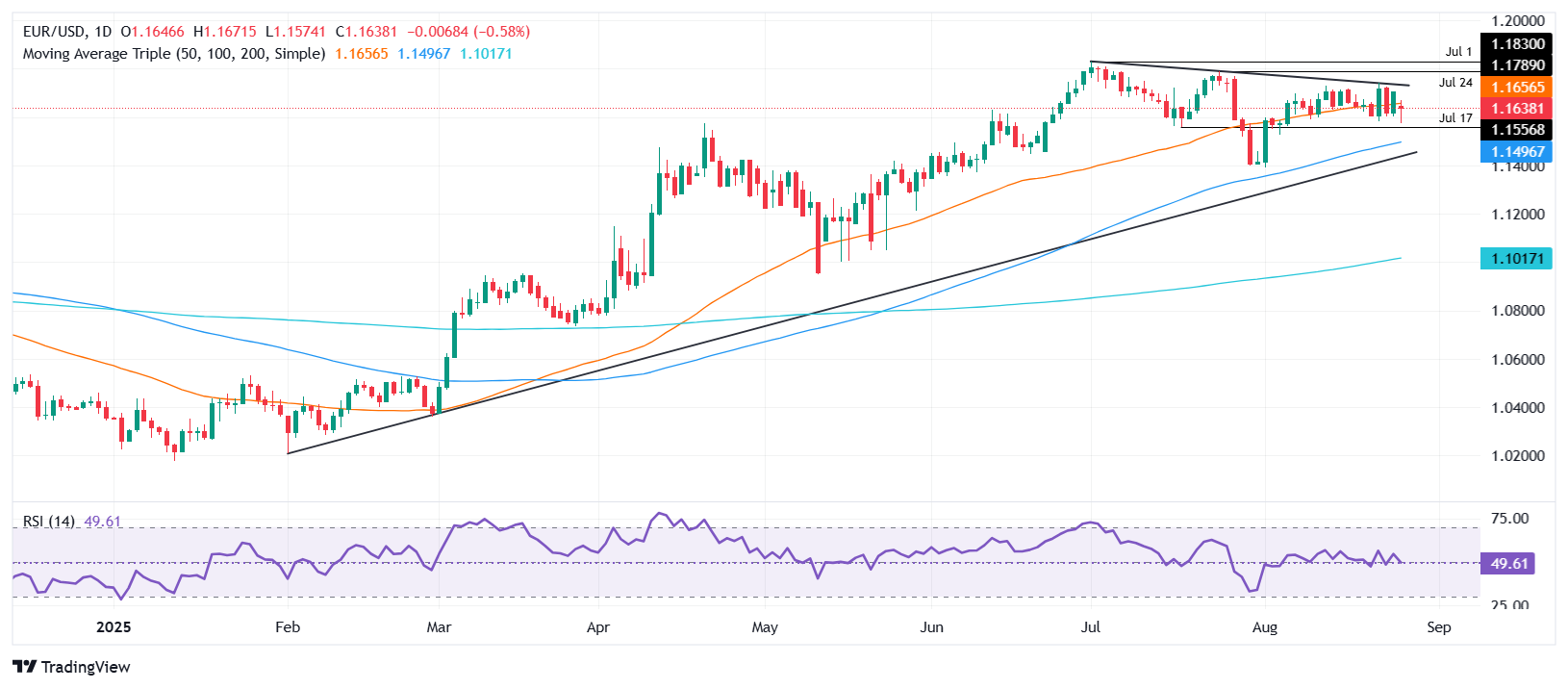
Technical outlook: EUR/USD hold firm around 1.1650
The EUR/USD uptrend remains in place, but the pull back towards the 20-day Simple Moving Average (SMA) at 1.1642, indicates the strong battle between bulls and bears, who remain unable to dictate the pair’s direction.
The Relative Strength Index (RSI) turned bearish, hinting that further downside is seen. However, the index remains close to its neutral level, an indication that bears are not out of the woods.
If EUR/USD drops below the 20-day SMA, the next support would be 1.1600, followed by the 100-day SMA near 1.1506. Conversely, if buyers regain control above 1.1650, EUR/USD could retest 1.1700, with the next resistance at 1.1742, the August 22 high.
Euro FAQs
The Euro is the currency for the 19 European Union countries that belong to the Eurozone. It is the second most heavily traded currency in the world behind the US Dollar. In 2022, it accounted for 31% of all foreign exchange transactions, with an average daily turnover of over $2.2 trillion a day.
EUR/USD is the most heavily traded currency pair in the world, accounting for an estimated 30% off all transactions, followed by EUR/JPY (4%), EUR/GBP (3%) and EUR/AUD (2%).
The European Central Bank (ECB) in Frankfurt, Germany, is the reserve bank for the Eurozone. The ECB sets interest rates and manages monetary policy.
The ECB’s primary mandate is to maintain price stability, which means either controlling inflation or stimulating growth. Its primary tool is the raising or lowering of interest rates. Relatively high interest rates – or the expectation of higher rates – will usually benefit the Euro and vice versa.
The ECB Governing Council makes monetary policy decisions at meetings held eight times a year. Decisions are made by heads of the Eurozone national banks and six permanent members, including the President of the ECB, Christine Lagarde.
Eurozone inflation data, measured by the Harmonized Index of Consumer Prices (HICP), is an important econometric for the Euro. If inflation rises more than expected, especially if above the ECB’s 2% target, it obliges the ECB to raise interest rates to bring it back under control.
Relatively high interest rates compared to its counterparts will usually benefit the Euro, as it makes the region more attractive as a place for global investors to park their money.
Data releases gauge the health of the economy and can impact on the Euro. Indicators such as GDP, Manufacturing and Services PMIs, employment, and consumer sentiment surveys can all influence the direction of the single currency.
A strong economy is good for the Euro. Not only does it attract more foreign investment but it may encourage the ECB to put up interest rates, which will directly strengthen the Euro. Otherwise, if economic data is weak, the Euro is likely to fall.
Economic data for the four largest economies in the euro area (Germany, France, Italy and Spain) are especially significant, as they account for 75% of the Eurozone’s economy.
Another significant data release for the Euro is the Trade Balance. This indicator measures the difference between what a country earns from its exports and what it spends on imports over a given period.
If a country produces highly sought after exports then its currency will gain in value purely from the extra demand created from foreign buyers seeking to purchase these goods. Therefore, a positive net Trade Balance strengthens a currency and vice versa for a negative balance.